hello and welcome to security management
201 I am professor wool and today we're
going to be talking about how to
structure and network objects to plan
for future policy growth so imagine that
you need to you have servers in your
data center you could probably
categorize your that your servers
according to multiple criteria such as
the operating system that they're using
maybe it's a linux server the function
that they're playing so maybe it's a
MySQL database the zone the network
segment that the server is going to be
located in so maybe it's in the blue
zone now each one of these categories
actually implies the requirement for
certain types of network access for
instance if it's a linux server then you
probably want these types of access so
you want to allow DNS access you want to
allow SSH for the IT administrators to
access that device whereas if it were a
Windows server then you would require
other types of access similarly if it's
a database server then you would
probably need SQL nets access from the
DBA workstations and if it's placed in
the blue zone then you want to allow
access from the blue zone security
operating system Center so that they can
troubleshoot so categorization implies
network access in many cases what you
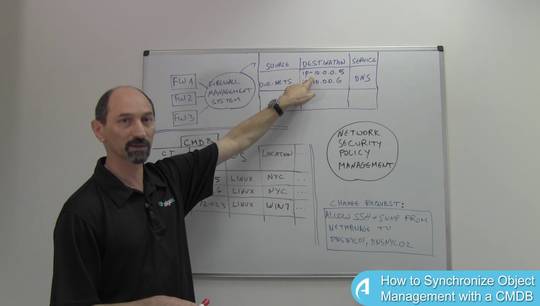
can do is use your firewall management
platform to construct templates that
implement these relationships and to do
that you would use your vendors network
object definitions so most firewall
vendors in their management platform let
you define named objects and then you
could define an object for let's say
your Linux servers and list all the IP
addresses of all the Linux servers that
you have in your data center similarly
you have a definition called the DB
servers and lists all the IP addresses
of the database servers that you have in
your data center you can of course have
the same ip address appear
in multiple different objects because
one server is both a Linux server and
the database server and something else
once you have these network objects
defined you write your rules according
to the templates of access that you need
so you would have a predefined rule
allowing access from all the Linux
servers to the corporate DNS using DNS
and you allow the IT staff to access the
Linux servers using SSH and so on and so
forth and the advantage of writing your
policy this way using network objects
that come from these categories is that
when you have a new server being added
to your data center what you really need
to do is just to add the IP address to
the appropriate objects and if you've
done that correctly then you don't need
to touch the policy rules because
they're already in place and all the
network access that is required because
it's a linux server because it's in the
blue zone all that access is already
baked into the firewall policy rules
which means that you have to do less
work and your policy is more compact and
allows you to grow more quickly now
there's a couple of things that you need
to bear in mind if you start using this
kind of structure the first is
discipline you really need to be
disciplined in how you put in rules in
your firewalls and make sure all the
team members are aware of the mapping
between let's say operating system
category to the object name in the
database so that when the new server is
added they remember to add that IP
address to that predefined Network
object rather than just add more rules
to the policy so discipline and training
of staff is important a bigger challenge
sometimes is what happens when you have
a multi multi vendor environment so if
you have firewalls from different
vendors each each vendor supplies their
own firewall policy management platform
and typically you cannot share Network
object definitions across vendors so if
you want to use this type of template
approach
you really need to define your Linux
servers object once on vendor number one
and again on vendor number two
preferably using the same name and it's
really important to get the content
exactly the same on all systems
otherwise you get diverging definitions
and the rules will not be consistent and
you've lost the advantage that you're
trying to achieve so if you have a multi
vendor environment as many organizations
do then of course you need even more
discipline and you also might want to
consider third party tools that are
multi vendor inherently and can let you
see a holistic view of all the
definitions of all Network objects
across your whole estate and with such
assistance you can get the same results
and have something automated ensure that
you don't make mistakes thank you for
your attention and see you next time