hello and welcome to this week's
security management course I'm professor
wool today we're going to be talking
about firewall object namings so what's
the story
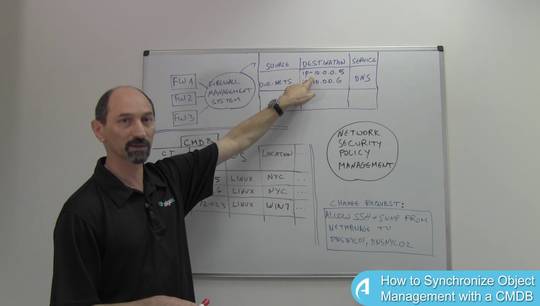
assume you have a server in your
environment and this is its identity
card this is a CMDB record so it has an
IP address 10 dot 3.0 that one has a DNS
name give heed Acme comm it is located
in the DFW data center and it is a
server type it's it's server type is
database so you have this system over
there in the data center and now you
need to put in firewall rules that refer
to this server and allow traffic to and
from it so how are people going to write
the rules that refer to this this server
so it really depends on how the firewall
met are managed and and what the fire
won't vendor lets you do so some
firewall vendors let you use the DNS
name so people might write rules that
refer to DB equal com other firewall
vendors require we require you to define
objects and give them name so an
engineer might call that server in a
rule you might call it IP dash and then
put the IP address some other engineer
might realize that this is a database
center database server and give it a
name DB just for convenience and each
engineer might have their own way of
calling things and you could have many
of these all referring to the same
server now the problem gets worse if you
have a diverse environment and you have
firewalls made by different vendors
because each vendor has their own rules
and how you can call things and let's
say on firewall B you might have to
write access lists and refire refer to
that server using some syntax like holes
and the IP address or something else so
the result of all of these different
ways of calling the same server is
management clutter and this is bad
because it makes managing these threes
rules across all your final estates
more complicated more error-prone
and you want to avoid it and part of the
reason why this is happening is that
unfortunately almost none of the major
firewall vendors give us a capability of
reverse lookup so if we have an IP
address we don't have a convenient way
of discovering what objects exist on the
firewall that refer to that IP address
and then people do their own thing and
you end up in a situation where you have
duplicates so what can you do to reduce
this problem so I can suggest a few
theif you tips that you could follow the
first is to clean up you could use
software to process your firewall rules
and search for duplicate definitions
find multiple objects with different
names that refer to the same IP address
report on them and then standardize and
clean them up so that's definitely a
good idea to get to a nice steady
baseline the second thing that you can
do is to define a naming convention so
this is a process-oriented
solution where you decide how you want
to call things and you could use as an
idea you could use names that begin with
a data center name and then something
about the server type and then maybe the
IP address and that's going to be the
officially sanctioned a m-- in firewall
rules for this server if you decide that
this is your naming convention and you
educate and train your firewall
engineers to always use the same naming
convention then they will reuse the same
definition over and over and not create
duplicates because when they decide to
create a rule that refers to an object
that already exists they will
automatically pick the right name for it
and if the object is already there they
will find it and once you have a naming
convention like this or something that
you invent the next thing is to enforce
it enforce the convention
here again you can use software to help
you if you have a change management
system perhaps you can program it to
automatically recommend using properly
formatted names when a change request is
made or perhaps you can configure it to
validate user-defined names and make
sure that the names fit the convention
so you can do this in different ways if
you follow these steps you're already in
a good place both in terms of cleaning
up the old history and in making sure
that going forward you're not making the
problem any worse instead you're making
it better thank you for your attention