hello and welcome to our lesson 9
professor world today we're going to be
talking about managing your security
policy in a mixed next generation and
traditional firewall environment so a
quick reminder in one of our previous
lessons we looked at next-generation
firewalls and the capabilities that they
provide us in managing security policy
at a much greater granularity so for
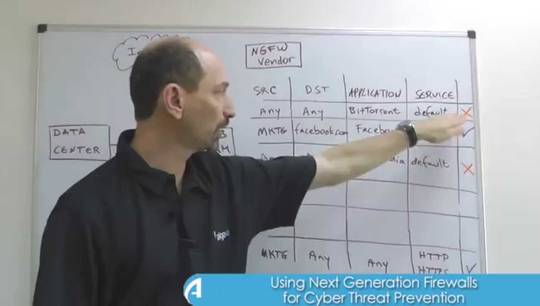
instance using a next-gen firewall you
can say things like that you want to
block the BitTorrent application from
anywhere to anywhere regardless of which
particular service protocol imports that
application uses so you can block it
specifically and the fire wall itself
knows the default ports that that
application might use or it may may even
have no default ports it might use all
ports so this gives us much greater
control over what we want to allow and
deny but now let's take a look at this
in terms of managing these policies when
we have a mixed environment so imagine a
situation like what you have over here
where you have a mixture of
next-generation firewalls like over this
one and you also have traditional
firewalls or filtering routers in your
environment and they all have to work in
a consistent manner to allow and deny
the things that you need to allow and
deny in particular let's imagine that
our general policy in the organization
is does not allow social media so there
is going to be a rule on the
next-generation firewall saying that
from any weight when we're social media
type services and applications are
denied that's just our corporate policy
in the organization of course we can do
that on a next-gen firewall because we
can specify the category without
specifying precise services and that's
that's very convenient but now we have a
situation where the marketing department
needs access to facebook which is one of
the social media services so we want to
allow this type of traffic and notice
that this traffic has to go through both
a traditional device and the next
generation device both have to be
configured so on the next gen device the
way you would write such a such a rule
you would say from let's say the
marketing department to facebook.com and
you'd use the predefined application
that is defined there you would use the
Facebook application with the default
settings and allow that traffic so you
can write that in the next generation
firewall because it already has a
predefined application called Facebook
and it knows how to identify that
particular traffic and allow it as
opposed to general social media which it
does not allow but what do you do with
the traditional fire wall behind it you
need to configure it as well and the
traditional firewall does not even have
an application column in the policy it
only has the traditional source
destination and service in action so you
need to do something here so obviously
you can say that you want to allow
traffic from marketing to facebook.com
but you need to put something in the
service you can't just put Facebook
because that's not something that the
traditional firewall knows so you would
have to really put something like HTTP
and HTTPS which are the default
protocols and ports that Facebook uses
so when you but notice that these two
rules look quite different
even though they're trying to honor the
same request and the point is that
somebody or some system has to know what
to put here and what to put here so the
request came in from the using the
terminology allow access to Facebook but
when we come to implement this change
request on a next-gen firewall we have
to specify the request in in terms of an
application name which is predefined and
the default ports but on the traditional
firewall we have to specify the actual
ports even this is much wider than this
but we have to know which ports the
place here now Facebook was an easy
example because it uses very well-known
ports but other applications might be
more obscure so the engineers
configuring this environment would need
to know this or have systems to a system
so this is something that you need to
bear in mind when you have a mixed
environment these kinds of differences
in terminology do affect how people do
their work when you're configuring the
devices thank you for your attention