you
hello and welcome to this week's
security management course I'm professor
world today we're going to be talking
about best practices in designing
network security zones so let's review a
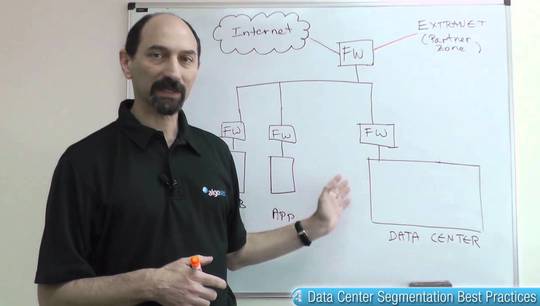
very simple example suppose you have a
network connection where you have your
internet you have an internal network
and you have a web application that has
a a web front and application zone and a
data zone and you put in a firewall the
simplest way to design such a network is
to have a single firewall that's
connected the way I show here well this
is a very basic design has two serious
problems the first is that these three
zones the web's own applications on the
day zone are not segregated from each
other traffic between them is completely
unfiltered it doesn't go through the
firewall so that's not good
and also this firewall is from a
security point of view a single point of
failure so if you miss configure that
firewall in any way your network
potentially becomes wide open and
research does show that 95 percent of
firewall breaches are really caused by
Mis configuration of a firewall so
getting that right is is crucial so what
can you do to improve the next step up
is to eliminate this simple network
structure and connect each one of these
zones directly to the firewall
to a separate interface on the firewall
once you do that traffic traveling
between these separate zones has to go
through the firewall and now you can
write policy on the firewall that
controls and filters the traffic between
these two three zones and also between
these zones and other parts of your
network from the outside to the inside
etc so this is more secure the challenge
here now becomes a physical challenge
each one of these connections takes up a
physical port on the firewall
and there is a limited number of
physical ports that you can have on the
firewall depending on the model so this
is a limiting factor and the next step
up is that technology lets us avoid
these physical connections using
virtualization of the network using
VLANs instead of having a physical
connection and use a physical interface
in each of these connections from the
zone to the firewall you can virtualize
all of them and have three separate
VLANs and the VLANs are all connected to
virtual interfaces on the firewall
running over a single high-speed
physical port and you can have a very
large number of VLANs you have much more
flexibility and still maintain the same
filtering capability and the same
granularity of access control policies
that you can instrument on the firewall
because crossing between VLANs does
require a firewall policy rule to allow
the traffic through okay so that good
the challenge now becomes that it's it's
become quite easy to define VLANs and
sometimes people over virtualize their
network and you end up with thousands of
VLANs and if you do that potentially you
end up with a firewall that
schematically would look like this it
would look like a spider it might have
hundreds or even thousands of VLANs
hanging off of that one firewall and if
you do that managing that firewall
becomes quite difficult because remember
if you have n different interfaces
virtual interfaces on the firewall then
you have N squared paths going through
the firewalls going from one interface
to another so you have N squared of
these paths and you have to manage the
policies of all those N squared paths
and then the policy on this firewall
becomes really complex and difficult to
understand and to manage so what could
you do to improve even further well now
you can
introduced individual pers own firewalls
like so and by doing this now you have
dedicated firewalls in front of each of
your security zones and that makes
management a lot simpler because each of
these firewalls is very focused this
firewall in the middle is just
protecting an application zone so the
rules on it only have to deal with that
application zone on the one side and the
policy on that firewall becomes much
more compact and much more focused and
easy to understand except that now you
look at this picture and you realize
that I've introduced a lot more devices
and now I have to worry about physical
boxes and I have to worry about power
supply and cooling and in rack space and
set etcetera and this is also something
that we wish to avoid so the final piece
of the puzzle is that we can use another
type of virtualization which is firewall
virtualization most or all major
firewall vendors let you purchase one
large box and have multiple separate
instances of virtual firewalls running
inside that box each of those individual
firewalls has its own policy it's
connected to its own VLANs and it does
exactly what I described before it's
protecting just the zone behind it
nevertheless they all reside inside the
single physical box so you get the best
of all worlds you have all the
granularity in filtering capabilities
and you minimize the number of Hardware
boxes that you need to worry about thank
you for your attention
Oh