hello and welcome to security management
201 I'm professor wool and today we're
going to be talking about how to
structure your security policy in a
segmented Network if you recall one of
the previous segments we talked about
segmenting your network and using
security zoning as a way to think about
how to structure your policy so today
we're going to be looking at one aspect
of such an organization of your security
policies to future-proof your work
against additional upcoming changes so
let's start with an example and we'll
see what I mean suppose you have a
network that's segmented into three
segments you have your orange zone over
here then you have the core network in
brown in the middle and you have the
blue zone on the right and there are
firewalls protecting all of these zones
from each other so there's a firewall
protecting the orange zone there's a
couple of firewalls protecting the core
network and there's a blue firewall
protecting the blue zone now with this
in mind you have a new change request to
deal with there is a need for the VMware
administrator to connect from his
administration workstation over here in
the arm zone to the ESX server over
there in the blue zone with this IP
address 3 at the end and as far well
administrator you need to allow this
traffic through from end-to-end so your
consult we're a net with your network
diagram and you realize that you need to
modify all 4 firewalls on this path the
orange one the two brown ones and the
blue one to allow this requested traffic
at this point I suggest to stop and
think for a second how you want to write
these rules in these four policies that
you have to update so what I'd like to
suggest is to think about these policies
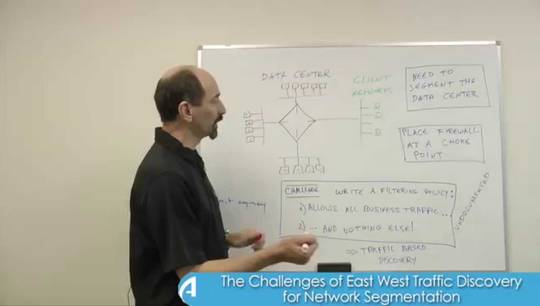
in a sort of diamond shape like this
sketch over here where it's sharp near
the source it sharp near the destination
and it's broad in the
and if you think about the way you want
to organize your put your whole policies
in this way you might save yourself work
in the future
specifically when you're close to the
source so you're over here in the orange
firewall that's right next to the source
you can be very specific regarding the
source or just lists the IP address of
the administration Works workstation so
just that one IP address but in terms of
destination you're very far away from
the Blue Zone in the terms of the
destination so you can just write the
whole subnet here so 172 dot one dot one
dot zero slash 24 so allowing traffic to
exit just from that one administration
system but it might it can go to
anywhere in the Blue Zone with the
VMware Service so that's the starting
point of the diamond if you look at the
other side at the blue firewall
protecting the blue zone here you're
very close to the destination so you
should be specific with regards to the
destination so just allow that one
destination but you're quite far away
from the source so you can allow all
traffic from the whole orange zone so
10.3 dot 0 dot 0 slash 16 in terms of
source and now when you have to look at
the intermediate firewalls protecting
the core network so they're not close to
the administration to the orange zone
and they're not close to the blue zone
either they're in the fat middle over
here you don't want to put specific
rules you want to put broad rules just
with zone to zone traffic so you'd put
the whole source zone
10300 slash 16 and the whole blue zone
wasn't 172 dot one dot one dot zero
slash 24 now notice that by writing the
rules in this way I have not introduced
any traffic that wasn't specifically
requested so I'm following the least
privileged principle because any traffic
using this VMware service going between
any other combination of IP addresses is
going to be
blocked somewhere either by the orange
zone firewall when it tries to exit the
orange zone or by one of the core
firewalls if it's coming from the wrong
direction or by the blue firewall if
it's trying to get into the blue zone
but not going to specifically do that IP
address so traffic that wasn't
specifically requested is not being
allowed by the combination of all these
rules but what I've done by introducing
wider objects and the source and the
destination in the intermediate steps
and just having one side of the rule
being very specific at the points is
that if in the upcoming weeks you'll
receive additional change requests that
are variations of this one so maybe from
that same Administration station the
administrators would need to get to
other servers in the Blue Zone or maybe
there are other administration
workstations that need to get to that
same service system in those upcoming
change requests should they occur you
might not need to touch the firewalls in
the core at all and maybe you'll just
need to touch one firewall either near
the destination or near the source so
your future proofing your policy and
saving yourself potential work in
upcoming change requests without giving
up any security for the immediate change
requests that you have to deal with
right now
so to conclude think about it in the
multi zoned segmented network with
multiple firewalls think about your
firewall policies as a whole across your
whole estate in this using this
diamond-shaped metaphor where you're
specific at the points and broad in the
middle if you do that you'll have a more
structured policy and you'll have to
work less with upcoming change requests
and in general you'll be able to do more
with your limited time so thank you very
much for your attention and see you next
time